BNS Section 258 Penalizes public officials who unlawfully commit someone to trial or confinement. Learn the offence, punishment, bail status, and its IPC equivalent.
India’s criminal justice system places enormous trust in those who hold legal authority — judges, magistrates, and officials empowered to detain or commit individuals to trial. But what happens when that authority is exercised corruptly, against the very law it is meant to uphold?
That is precisely what BNS Section 258 addresses.
Part of the Bharatiya Nyaya Sanhita (BNS), 2023 — which replaced the Indian Penal Code, 1860 — this provision is a critical safeguard against the misuse of institutional power. If you’re studying criminal law in India, this section deserves careful attention.
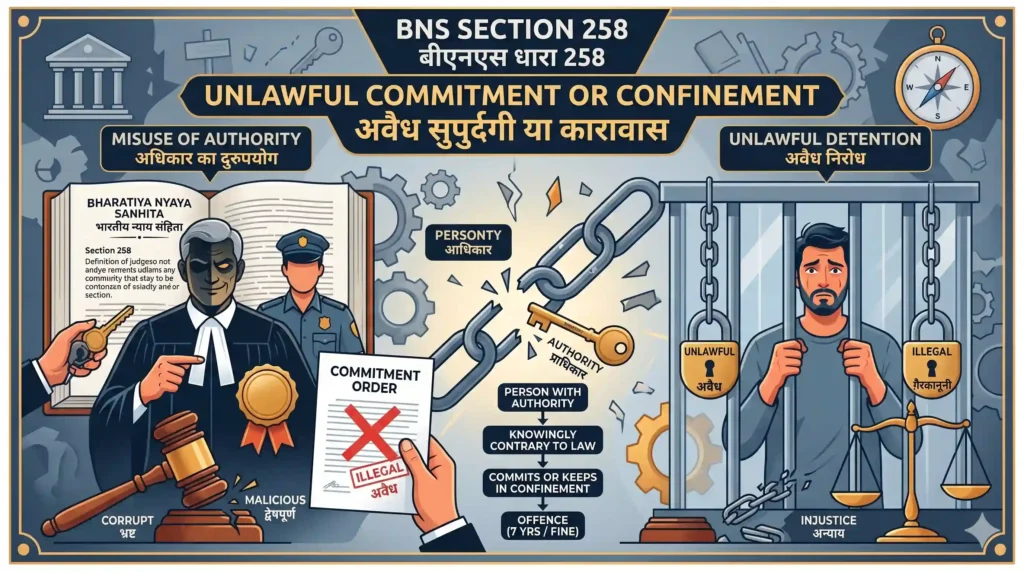
What is BNS Section 258 ?
BNS Section 258 provides that whoever, being in any office which gives him legal authority to commit persons for trial or to confinement, or to keep persons in confinement, corruptly or maliciously commits any person for trial or to confinement — or keeps any person in confinement — in the exercise of that authority, knowing that in so doing he is acting contrary to law, shall be punished.
The key phrase here is “knowing that he is acting contrary to law.” This is not about an honest mistake or a procedural oversight. The offence requires mens rea — a guilty mind. The authority figure must know their action is unlawful and proceed anyway, either corruptly (for personal gain or favour) or maliciously (with intent to harm).
Breaking Down the Essential Elements
For BNS Section 258 to be invoked, four things must be established:
1. A position of legal authority — The accused must hold an office that grants the power to commit persons to trial or confinement. This typically includes judicial officers, magistrates, or officials of detention facilities.
2. An act of commitment or confinement — The accused must have either sent someone for trial, placed them in confinement, or continued to keep them confined.
3. Knowledge of illegality — The person must know at the time of the act that what they are doing is contrary to law. Ignorance of the law is not a defence here, but neither is this provision a trap for genuine mistakes.
4. Corrupt or malicious intent — The act must be driven by corruption or malice, not by error. This is what elevates the conduct from a procedural wrong to a criminal offence.
BNS Section 258 Punishment, Bail, and Jurisdiction
The punishment under BNS Section 258 is imprisonment of either description for a term which may extend to seven years, or fine, or both.
Here’s a quick summary of the procedural classification:
| Aspect | Detail |
|---|---|
| Offence | Unlawful commitment for trial or confinement by an authority |
| Punishment | Up to 7 years imprisonment, or fine, or both |
| Nature | Non-cognizable |
| Bail Status | Bailable |
| Trial Court | Magistrate of the First Class |
The non-cognizable classification means police cannot arrest or investigate without prior magistrate approval. The bailable nature means the accused has a right to bail. These procedural details matter enormously in practice — and are frequently tested in law exams.
Frequently Asked Questions :-
What is BNS Section 258 about?
It penalises public officials who knowingly and unlawfully commit a person to trial or confinement, either corruptly or with malicious intent.
What is the maximum punishment under BNS Section 258?
Imprisonment up to seven years, or a fine, or both.
Is BNS Section 258 a cognizable offence?
No. It is non-cognizable, meaning police require prior magistrate Authorization before arrest or investigation.
Is the offence under BNS Section 258 bailable?
Yes. The accused has a legal right to seek bail.
Which IPC section does BNS 258 replace?
BNS Section 258 corresponds to Section 220 of the Indian Penal Code, 1860.
Which court tries offences under BNS Section 258?
A Magistrate of the First Class has jurisdiction to try this offence.
Read Also-
